Grab Bar Installation in Thornhill
Someone in your Thornhill home needs a solid handhold at the toilet, the tub or the stairs, and it has to hold a full body's weight on the first pull.
Yes. We install grab bars in Thornhill as part of our mounting work, along with second stair handrails, shower seats and handheld shower holders. Every bar is fastened into studs, solid blocking or anchors made and rated for grab bars. Tile is drilled without cracking it, and heights are set with the person who will use the bar.
On this page
- What a grab bar has to be fastened to
- Drilling tile without cracking it
- Where bars usually go, and who decides
- Second handrails and other safety hardware
Get a quote for this job
What does a grab bar have to be screwed into?
Something that will not let go when a person slips and grabs it with their whole weight. That rules out most of what holds a towel bar.
- Wood studs. The first choice. Both flanges land on framing where the layout allows, with stainless screws long enough to pass the tile, the backer board and well into the stud.
- Solid blocking. A length of lumber fixed between two studs behind the wall, put there for this purpose. Bathrooms renovated with a bar in mind often have it.
- Anchors rated for grab bars. Where a stud is not where the bar needs to be, there are hollow-wall anchors designed and load-rated specifically for grab bars. We use those and nothing lighter.
Plain plastic plugs, ordinary drywall anchors and suction-cup bars are not safe handholds. A suction bar can release without warning, and we do not install them as support.
Studs rarely sit exactly where a hand wants to be. A bar set on an angle, or a longer bar, can often reach two studs where a short level one cannot.
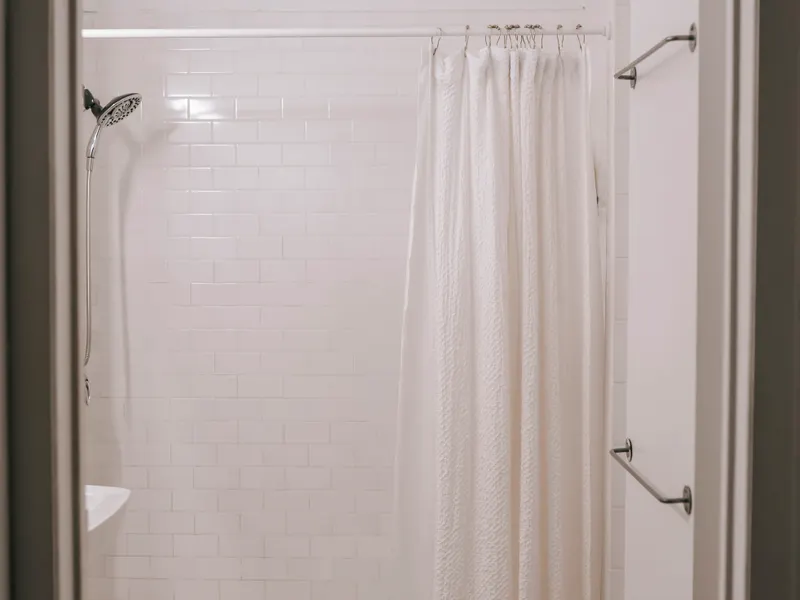
Can you drill through tile without cracking it?
Yes, with the right bit and patience. Porcelain is harder than the steel in an ordinary drill bit.
- Mark the holes on masking tape so the bit does not skate across the glaze.
- Drill with a diamond bit at low speed, kept wet, with the drill's hammer action switched off.
- Once through the tile, change to a wood bit for the stud behind.
- Fill each hole with silicone before the screw goes in, and run a bead behind the flange.
The silicone matters in a shower. An unsealed screw hole lets water into the wall every time the tap runs.
We keep holes away from the edge of a tile, where it chips most easily. Moulded acrylic and fibreglass tub surrounds are hollow behind, so they need a look before we say what is possible.
Where should the bars go?
The common spots are beside the toilet, on the wall at the tub's entry point, and inside the shower near the controls. A vertical bar helps with stepping over a tub edge. A horizontal or angled one helps with sitting down and standing up.
Heights are not read off a chart. We set them with the person in the room: they sit, stand and reach, and we mark where the hand naturally lands. A bar placed for someone else's height gets used less.
If an occupational therapist has given your family written recommendations, send them. We follow the positions on that sheet.
We install hardware. We do not assess anyone's mobility or advise on medical needs, and we make no claim that an installation meets any accessibility standard.
What about the stairs?
Many Thornhill houses from the 1960s to the 1980s have an oak railing on the open side of the stairs and nothing on the wall side. A second handrail gives a grip for each hand.
The rail brackets are screwed into studs, not drywall, and the new rail is set to match the height of the existing one so both hands travel level. The ends are returned to the wall so a sleeve or bag strap cannot catch.
Basement stairs with one loose rail get the same treatment: new brackets into framing, or into the concrete wall with drilled anchors.
Other safety hardware we fit
- Wall-mounted fold-down shower seats, fastened into studs or blocking the same way as a bar.
- Handheld shower holders and slide bars, so the spray can be reached from a seat.
- Raised toilet seats and toilet safety rails that clamp to the bowl's seat bolts.
Moving a shower valve or adding a new water line for a handheld is a plumber's job. A handheld that threads onto the existing shower arm is not.
Grab Bars & Senior Safety questions
Can a towel bar double as a grab bar?
No. Towel bars are thin tube held by small set screws, and they bend or pull out under body weight. Replace it with a real grab bar in the same spot.
Can you install a bar in a condo bathroom?
Yes. Condo bathroom walls are usually steel studs or concrete behind the tile, and each needs its own anchor. Ask your property manager about permitted work hours for drilling.
What finish should I choose?
A knurled or peened grip holds a wet hand better than polished chrome. Stainless steel suits a shower because it will not rust at the screws.
Can a bar go on a glass shower wall?
No. Bars go on a framed or concrete wall beside the glass, never on the panel or its frame.
Tell us who the bars are for and where
Send photos of the bathroom or stair walls through the quote form. Mention any therapist's recommendations and whether the walls are tile, drywall or a moulded surround.