Pressure Washing in Thornhill
You want a winter of road salt, algae and grey film washed off the driveway, patio or fence at your Thornhill house, without the surface getting chewed up.
Yes. We pressure wash driveways, interlock, walkways, patios, steps, decks, fences and ground-level siding across Thornhill, alongside our other outdoor repair work. Each surface gets its own pressure, tip and distance, because the setting that cleans concrete will scar cedar. We work from your outside tap, between spring and fall.
On this page
- Pressure and tip for each surface
- Why wood and interlock joints need a lighter hand
- Where water must not be driven
- Season, water supply and runoff
Get a quote for this job
What pressure does each surface need?
| Surface | How we wash it | What goes wrong if it is rushed |
|---|---|---|
| Poured concrete driveways and steps | Higher pressure with a 15 or 25 degree tip, or a flat surface cleaner | Zebra stripes from the wand, etched lines where the tip paused |
| Interlock and patio stones | Medium pressure, fan tip held at a low angle across the joints | Joint sand blown out and pavers left rocking |
| Deck boards and fence boards | Low pressure, a 40 degree tip, about a foot back, moving with the grain | Raised, furry grain and gouges that show through any stain |
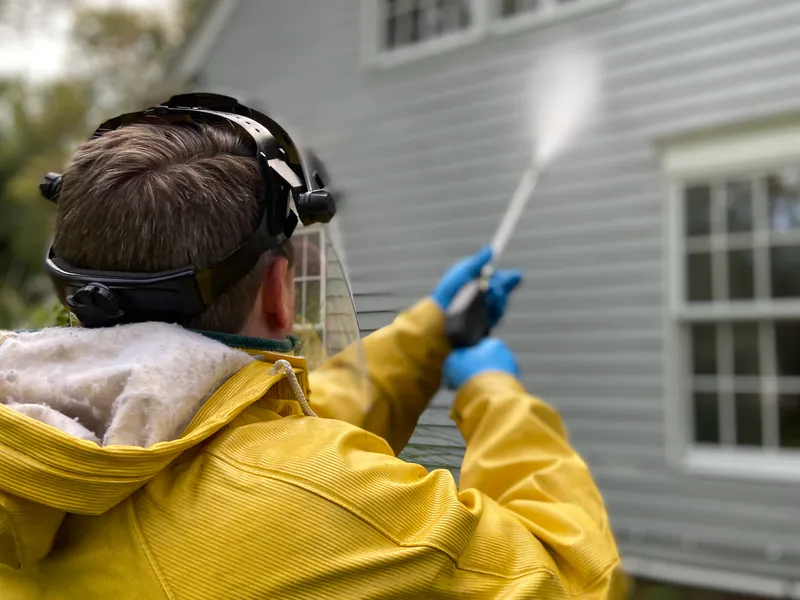
| Vinyl and aluminum siding | Soft wash: a cleaner put on at low pressure, then a gentle rinse downward | Water forced up behind the laps and into the wall |
| Brick | Low pressure and a wide tip, kept moving | Eroded mortar and soaked weep holes |
The red zero-degree tip stays in the case. It cuts a pencil-wide line into nearly anything a house is made of.
Will pressure washing damage a deck or a fence?
It can, and quickly. Softwood such as cedar and pressure-treated pine has hard and soft bands in every board. Too much pressure, or a tip held too close, digs out the soft bands and leaves the surface fuzzy and ridged. Those scars do not sand out easily.
So wood gets the widest tip, the lowest pressure that still lifts the grey, and long passes that follow the grain from one end of the board to the other. Stopping mid-board leaves a lap mark.
Washing a deck ahead of staining is a different job with its own drying time, and it is handled as part of our deck staining work.
What happens to the sand between interlock pavers?
Some of it leaves. The joints between pavers are filled with polymeric sand, which hardens when wetted and locks the stones together. A washer strong enough to lift moss and black algae from the joints takes the top of that sand with it.
Once the pavers have dried right through, new polymeric sand is swept in, compacted, blown off the faces and misted to set it. It needs a dry day or two after that, so the forecast decides when the job is booked.
Where does the water have to stay out?
- Weep holes. The small gaps along the bottom course of brick and in the lower edge of window frames are drains. We wash down and away from them.
- Door thresholds. A wand aimed at the bottom of a door pushes water past the sweep and onto the floor inside.
- Vents. Dryer, bathroom and furnace vents and soffit vents are openings into the house. They are washed around, not into.
- Outlets and light fixtures. Outdoor covers shed rain. They are not built for a jet from below.
Exterior paint on houses built before 1960 is likely to contain lead, and paint up to 1990 may. That takes in the old village houses and a good share of Thornhill's 1960s to 1980s streets. We do not blast flaking paint off those surfaces with a washer, since it scatters chips across the yard.
When in the year, and what do we need from you?
Pressure washing is done above freezing, from spring to fall. Water left in a hose, a pump or the pores of concrete on a frosty night does damage, and a wet walkway becomes a sheet of ice.
The machine runs off your outside tap. If the tap was shut off indoors for the winter, open that valve before we arrive. Move cars off the driveway, close the windows and bring in cushions and doormats.
Runoff matters too. Storm drains on the street are not treated like the water from your sink: they empty into creeks. Plain rinse water is fine. Degreaser, oil lifted from a driveway stain and paint flakes are kept on the property or collected, not chased down the curb.
Pressure Washing questions
Do you wash second-storey siding or roofs?
Asphalt shingles are never pressure washed, because the jet strips off the protective granules.
Will washing take out oil and rust stains?
A degreaser lightens fresh oil. Oil that soaked into concrete long ago leaves a shadow, and rust from fertilizer or patio furniture needs its own cleaner.
How soon can I park on the driveway afterward?
On concrete, once it has dried. On interlock that has been re-sanded, wait as long as the sand maker's instructions say.
Can you pressure wash a condo balcony?
The water lands on the balcony below, so most buildings restrict it. Ask your property manager what is allowed before you book.
Show us the surfaces you want washed
Photograph each area, give rough sizes and tell us where the outside tap is, all in the quote form.